Great Maritime Expeditions set sails
How can we better promote the heritage of the great Atlantic expeditions? This is one of the key challenges addressed by the European Interreg Atlantic Area Agree programme. Three members of the Atlantic Union, specialists in heritage and tourism, are involved in the project, whose ultimate aim is to establish a Cultural Route of the Council of Europe.
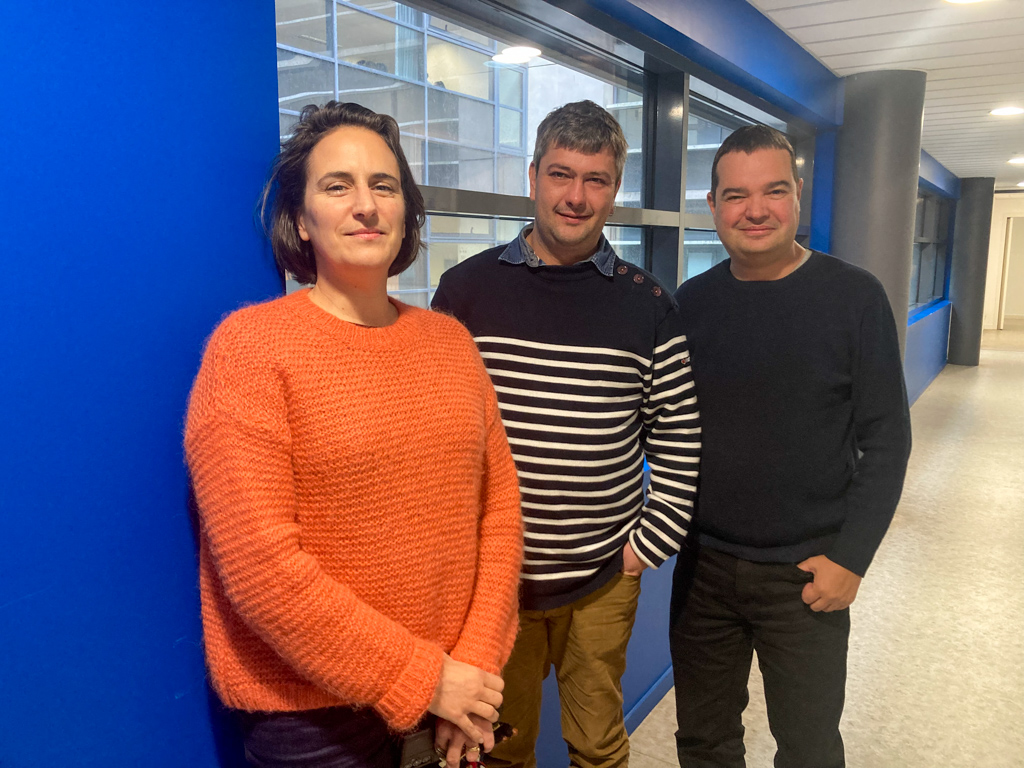
Hélène Pébarthe-Désiré, Quentin Brouard-Sala and Johan Vincent are collaborating on this European project.You’re probably familiar with the concept of a wine route winding through your favourite vineyard. But did you know that there are European equivalents, known as the Council of Europe Cultural Routes, of which there are currently 49: the Routes of Santiago de Compostela, the Viking Route, the European Route of Historic Pharmacies and Medicinal Gardens…
The seeds of another project have just been sown. It aims to highlight the Age of Discovery explorations that set sail from the Atlantic coast between the 15th and 18th centuries, led by Christopher Columbus, Amerigo Vespucci and Jacques Cartier. To help it come to fruition, the European Union has agreed to fund a 30-month programme, under its Interreg Atlantic Area scheme, for a total of €1.79 million.
Led by the province of Huelva in Andalusia, the programme brings together ten partners from Spain, Portugal, France and Ireland, including local authorities, the Atlantic Cities network and the Portuguese technology park in Sines, as well as four universities, including the University of Angers. While the main objective is to establish a network of organisations and stakeholders interested in promoting major expeditions (a prerequisite for obtaining the European label), the programme also includes a scientific component focusing on the history of these transatlantic exchanges and the promotion of this heritage. "They approached us because we have expertise in heritage and tourism," explain the three Angers researchers involved in the Agree project.
Exchanging perspectives
As a historian specialising in heritage and culture in coastal areas, Johan Vincent will be focusing particularly on the first area of research. “We already know a great deal about the major expeditions in each country, but when we examine things more closely, there will likely be connections that emerge, things we hadn’t noticed before,” predicts the senior lecturer at Esthua-Innto France, a member of the Temos unit. “That’s what’s interesting: the crossing of different European perspectives.”
The second area of focus will involve his colleague from Esthua, Hélène Pébarthe-Désiré, a senior lecturer in geography attached to the Espaces et sociétés (ESO) laboratory, who studies in particular the role of tourism in local development, and Quentin Brouard-Sala, a research engineer, also from the ESO unit, a specialist in the promotion of small and medium-sized towns through heritage. “We will, for example, study how this heritage relating to the great expeditions is showcased,” says Hélène Pébarthe-Désiré. “And also look at how major museums deal with these issues,” adds Quentin Brouard-Sala.
Everyone hopes that sensitive issues such as colonisation and slavery will not be sidelined. “We’re going to try to understand why some cities have undertaken remembrance initiatives, such as the Memorial to the Abolition of Slavery in Nantes, while others have not,” explains Hélène Pébarthe-Désiré. “We also want to see how this played out for the destinations of arrival in the West Indies and the Indian Ocean.”
Concrete initiatives are planned for four pilot regions. “Each region already promotes this history,” says Quentin Brouard-Sala. “The aim here will be to update this promotion, for example by funding initiatives to enhance public engagement and digitise museum collections.”
Press release
The Agree project kick-off meeting took place on 26 January 2026 in Huelva. Here is the official press release issued following the event:
