Can lasers make prostheses safer?
A thesis will attempt to demonstrate the benefits of modifying the surface of medical prostheses using an ultra-short laser in order to avoid bacteriological risks. The research is being conducted by Antony Ménard at Lphia, in collaboration with the University of Magdeburg, as part of EU-Green.
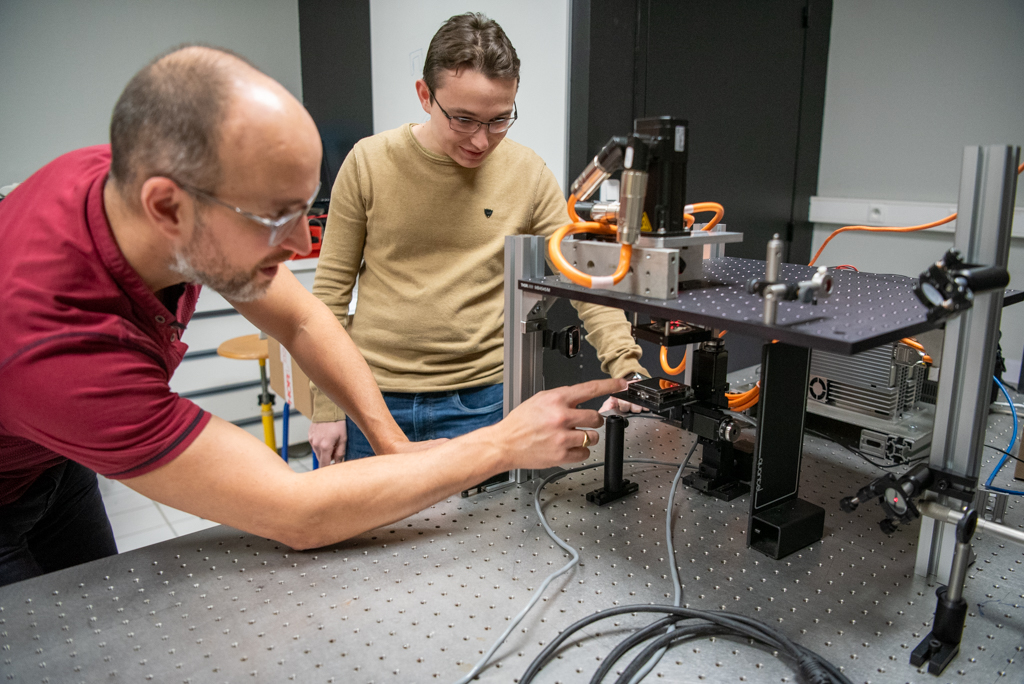
Cyril Mauclair and Antony Ménard in the experimentation lab.Hip replacements, dental implants... Although titanium devices have proven their worth and are generally well accepted by the human body, their use nevertheless carries a risk of infection. "Hip replacements, dental implants... Although titanium devices have proven their worth and are generally well accepted by the human body, their use nevertheless carries a risk of infection," explains Antony Ménard, who holds a master's degree in physics from the University of Bordeaux.
This vulnerability is due in particular to the smoothness of the materials. Research has shown that "materials with microscopic scratches slow down the growth of bacteria, and the smaller the scratches, the harder it is for bacteria to develop colonies." he continues. The young PhD student began his thesis at the Angers Photonics Laboratory (Lphia) in October 2025. "The condition of the surface will either facilitate or hinder bacterial activity", summarises his thesis supervisor, Cyril Mauclair, a senior lecturer in photonics, who began working on the subject nearly 10 years ago.
Modelling the surface
The recent democratisation of femtosecond lasers, which produce ultra-short pulses and were once very expensive, offers new possibilities. This precision tool can be used to create nanostructures on the surface of materials. However, the most appropriate pulse power and duration for modelling the surface still need to be determined. Which geometric shapes should be produced to maximise the inhibition of bacterial growth? "For example, we could take inspiration from the patterns found on lotus leaves, with bumps and a kind of down that repel water and bacteria and give them self-cleaning properties," explains Cyril Mauclair.
These issues are at the heart of the thesis project entitled Fibral for Femtosecond Laser-Structured Biocompatible Alloys for Enhanced Implant Durability and Integration. The complex manipulations, carried out in the Angers laboratory under the control of scanners, will have to prove their effectiveness. This will be the role of the Institute of Materials, Technologies and Mechanics (IWTM) at the University of Magdeburg, which, under the responsibility of its director Manja Krüeger, will study the properties of the surfaces created at UA and their reaction to bodily fluids.
This collaboration was born within the EU-Green European University Alliance. As part of this, Antony Ménard will spend two periods of several months in Germany to monitor the tests on the nanostructures he has developed. And Lhpia will welcome a PhD student from Magdeburg in spring 2026 so that she can learn the necessary techniques.
