Eiffel Scholarships: Attracting Promising Talent
Since October, the University of Angers has welcomed a promising young Indian researcher thanks to the France Excellence Eiffel scholarship programme. For the next three years, Shreya Dey will carry out her doctoral research within UA’s Mint (Micro and Nanomedical Translation) research unit, focusing on improving treatment effectiveness for lung cancer.
Funded by the Ministry of Foreign Affairs and implemented by Campus France agency, the Eiffel Excellence scholarship programme enables French institutions to attract top international talent at the master’s and doctoral levels. An international panel of experts evaluates both the scientific quality of the host laboratories’ projects and the academic excellence of the candidates.
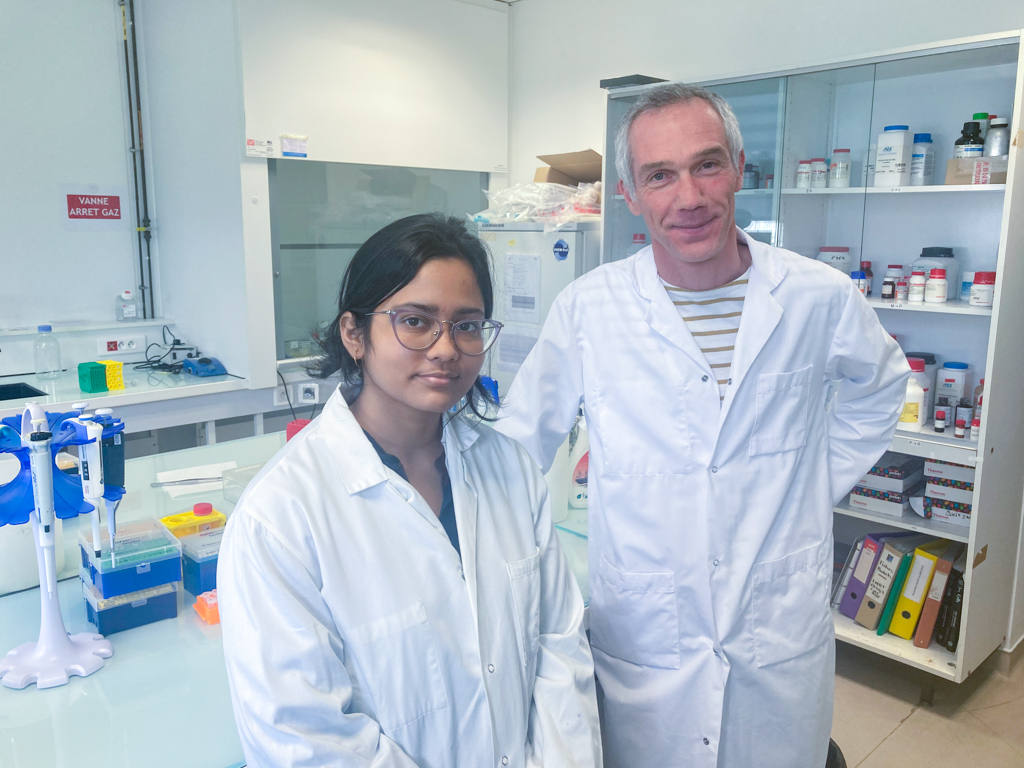
Shreya Dey and Nicolas Clere, in the Mint research laboratory
It is within this framework that a collaboration was established between the Mint (Micro et nanomédecines translationnelles) research unit at the Angers Health Cluster and Shreya Dey, a 23-year-old graduate in biological sciences from the Indian Institute of Science Education & Research (IISER), Kolkata.
Shreya will lead the Stroma project, which focuses on understanding how cells within the tumour microenvironment of non-small cell lung cancer influence treatment response.
“In these cancers, tumour cells interact with surrounding cells that contribute to tumour development. Our goal is to understand how this dialogue affects the rigidity of the extracellular matrix, a key factor in how patients respond to therapies,” explains Nicolas Clere, professor of pharmacology at the University of Angers. He will supervise the PhD project alongside Sophie Lelièvre, professor of pharmacology and researcher at the Institut de cancérologie de l’Ouest (ICO).
Win/win
Shreya Dey's profile caught the attention of the Angers team. "In India, as part of her master's degree, she developed experimental models that will be useful in this study," notes Nicolas Clere. The PhD student was attracted by the project: "I didn't really want to come to France in particular, but I was looking at different projects. And I liked this one. I thought I could learn a lot," she says in English.
Having taken up her post in Angers on 1 October, she is discovering a new language and a new city. "People have been very helpful," she says in a reassuring tone. She has three years to complete her thesis and bring the Stroma project to fruition. During this period, she will receive a grant from Campus France of €2,100 per month.
In addition, the Stroma project has obtained €90,000 in funding from the Pays de la Loire Institute for Respiratory Health Research (IRSRPL) to cover operating and experimentation costs.
