Towards an innovative design of molecules for optoelectronics
The ANR Cesiom programme brings together chemists from Moltech and computer scientists from Leria to develop a strategy using artificial intelligence to model and create new organic molecules that react to near-infrared light. The work is among the winners of the National Research Agency's 2025 call for projects.
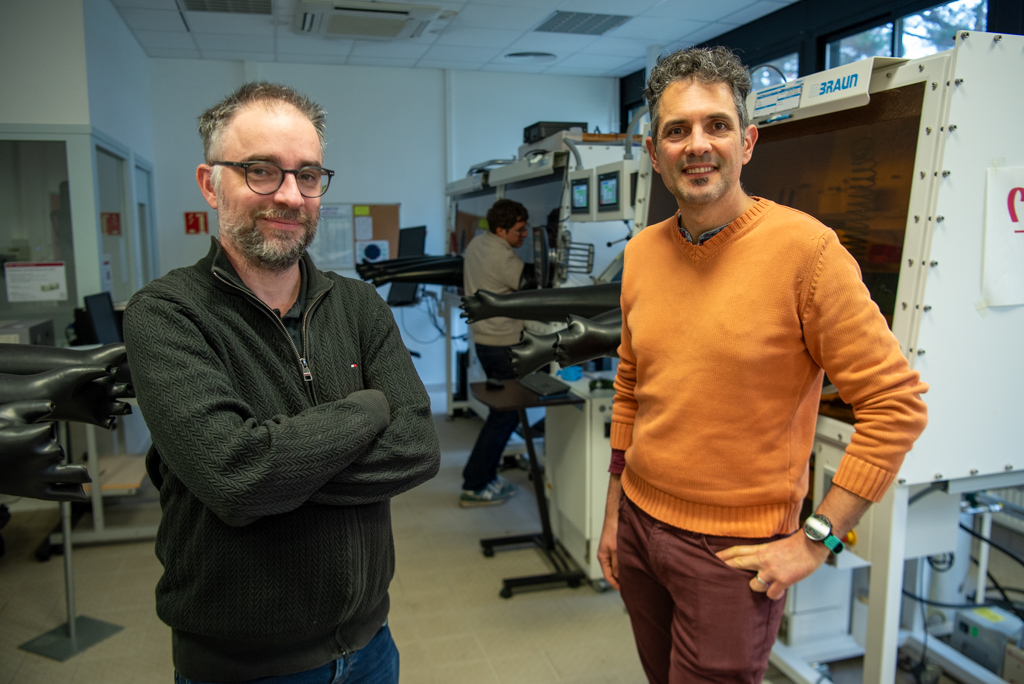
Benoit Da Mota (Leria) and Thomas Cauchy (Moltech) collaborate on this project.A team at the Moltech-Anjou chemistry laboratory, led by Maxime Rémond, a CNRS research fellow, is working on OLEDs (organic light-emitting diodes) capable of emitting light in the near-infrared region, the part of the electromagnetic spectrum that lies just beyond the visible spectrum. “Near-infrared light penetrates the skin. So one could imagine controlling therapeutic treatments in this way. The problem is that there are very few of these molecules at present, and they are often unstable, which makes creating new ones a real headache. Even artificial intelligence struggles with this.” explains Thomas Cauchy, a senior lecturer in chemistry and modelling specialist. “There are so few examples that traditional machine learning models struggle to generalise to new molecules,” adds Benoit Da Mota, a senior lecturer in computer science. “That is why we want to use new hybrid AI methods, combining combinatorial optimisation techniques, the study of fitness landscapes and the use of surrogate models.”
Molecule generator
One of the objectives of the Cesiom programme (Computational-Experimental Synergy for Innovative Optoelectronic Molecule Design) will be to develop a molecule generator based on evolutionary algorithms. “We start with a molecule, and the generator applies a small modification. We check that it is chemically plausible, calculate its score of interest, before a new mutation, and so on until we find an interesting combination.”
The programme will first need to define what constitutes a “good molecule” – one that shows promise. Thomas Cauchy will work on this topic in collaboration with the Institute of Chemical Sciences in Rennes. A PhD thesis is also planned.
The computer science aspect will also be the subject of a PhD thesis, which Chaïmaâ Touhami began on 1 October 2025, the official launch date of Cesiom.
The third part of the project will put the theory to the test: “Molecules of interest identified by the generator will be synthesised to verify that they do indeed match the targeted characteristics,” summarises Thomas Cauchy. “And this won’t always be straightforward, with real challenges to overcome in their synthesis.” This experimental phase will be carried out in the Moltech laboratories at the Faculty of Science in Angers, with the support of an engineer.
The entire project has received funding from the French National Research Agency (ANR), which has awarded Cesiom a grant of €553,000 over 48 months.
