Angers, the world capital of mitochondrial medicine
From May 31, 2026 16:00 to June 4, 2026 18:00
For almost a week, Angers will host more than 850 researchers, doctors and specialists for the EuroMit 2026 international conference. This is the world’s leading event in the field of research into diseases involving mitochondria, the powerhouses of our cells. This will be an opportunity to share the latest developments in this field, including research findings and clinical trial results.
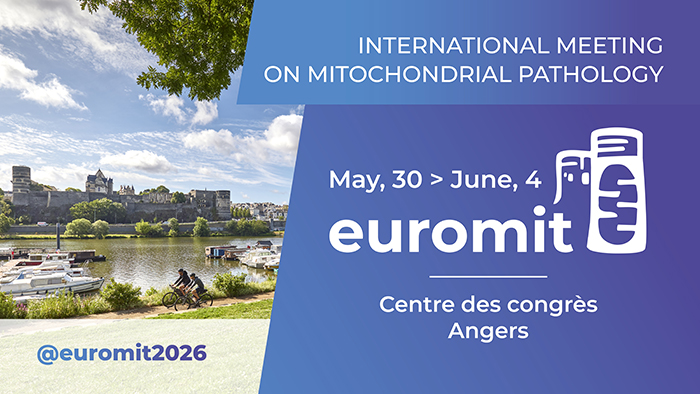 Since 1989, the scientific community studying mitochondria and the impact of their dysfunction has made a habit of meeting every three years at a major international conference. Following Cologne (Germany) in 2017 and Bologna (Italy) in 2023, the event will take place in Angers this year, from 31 May to 4 June. This is only the second time that France has had the honour of being chosen to host this congress. And the choice of Angers is no coincidence.
Angers University Hospital is one of France’s five centres of excellence for mitochondrial diseases. The hospital works closely with the Mitovasc joint research unit (University of Angers, Inserm, CNRS), and in particular its Mitolab team, which specialises in mitochondria. “With nearly 70 members, including researchers and doctors, we are the largest team working on mitochondrial diseases in France,” says Guy Lenaers, director of Mitovasc.
Improving diagnosis, understanding mechanisms and developing new treatments for these rare and complex diseases requires a whole ecosystem to work together to expand our knowledge and the solutions available to patients. This work is supported by patient organisations (AFM Téléthon, Association contre les maladies mitochondriales (AMMi), Ouvrir les Yeux...).
40 nationalities
The Angers Convention Centre will welcome more than 850 participants from across five continents for five days of scientific presentations and discussions. The event will officially launch on Sunday 31 May at 4:30 pm, after the E-Mit (European Society for Mitochondrial Research and Medicine) general assembly. E-Mit is organising the event alongside Mitovasc, the University Hospital and the University of Angers.
The opening lecture will be given by Professor Patrick Chinnery (University of Cambridge), one of the leading specialists attending the conference in Angers, joined by other world-renowned figures such as Finland’s Anu Suomalainen. Over 70 speakers will take the floor across eight thematic sessions. “A few years ago, presentations focused heavily on genetic causes and understanding,” recalls Guy Lenaers, CNRS research director, who is spearheading this year’s event together with Professor Vincent Procaccio, a geneticist (Angers University Hospital and Mitovasc). “For this edition, focus will still be on understanding, but also on treatments, including clinical trials. We can see that progress is being made.”
On Thursday afternoon, 4 June, a session will be dedicated to patients (diagnosis, care, etc.). Around a dozen organisations will be represented.
To open the five-day official conference, approximately 180 young researchers will present their work on Saturday 30 May at the Conference Centre.
But what exactly are mitochondria?
Mitochondria are found in every cell and possess their own DNA. They have many functions, including synthesising ATP, which is essential for cellular life.
Genetic mitochondrial dysfunction is implicated in nearly 400 rare diseases, which often affect organs requiring greater energy (the brain, eyes, heart, skeletal muscles, etc.). Symptoms vary widely, making it difficult to identify these diseases.
“What we are learning about rare diseases involving mitochondria,” explains Olivier Baris, director of the Mitolab research team, “also informs us about common diseases,” such as cardiovascular, neurodegenerative, or metabolic conditions like diabetes.
